Investment in The Bronx
I was born and raised in The Bronx, as was my mother. My grandparents moved here some 50 years ago when the northern half of The Bronx was all new construction. It was pleasant enough to grow up here, but the problem The Bronx has is that the minute you grow up and go to college there is not much for you here and you basically must leave in order to go forward in life. There were so many times when I would come back from college or when I visited from Tel-Aviv and I would be looking for products and services that were just not available in The Bronx. As a result, I am forced to conduct all of my business and leisure in Manhattan and occasionally Brooklyn. I practically live on the express bus.
One day a couple years ago as I made my way into Manhattan on the Bruckner Expressway, I looked closely at the buildings surrounding the highway, especially towards the waterfront area and the swath of Port Morris between the Triboro and Third Avenue bridges and saw all these "For sale" signs on charming but run down brownstones. I thought, "Wouldn't it be great to buy all this up, rehabilitate it and make some nice housing out of it?" We could attract services into the area so that I don't have to commute an hour into Manhattan for every little thing. The Bronx could become a destination and not a place from which to escape. I stumbled upon the Clock Tower building and the antique shops surrounding it and thought "We could make this into the next Tribeca" (little did I know at the time that Adolfo Carrion, the Bronx Borough President, had the same idea and that this area was part of his plan for revitalizing the South Bronx).
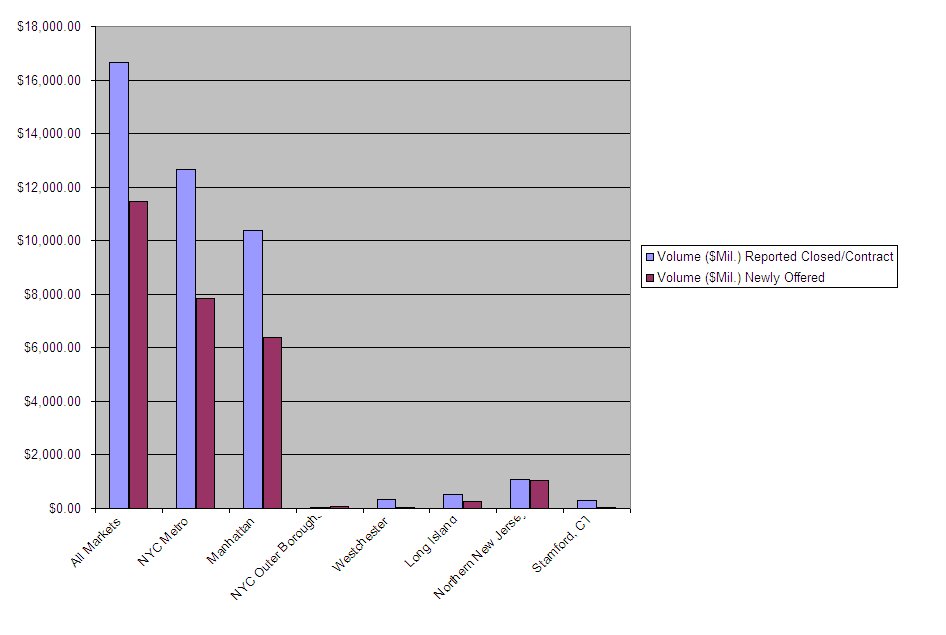
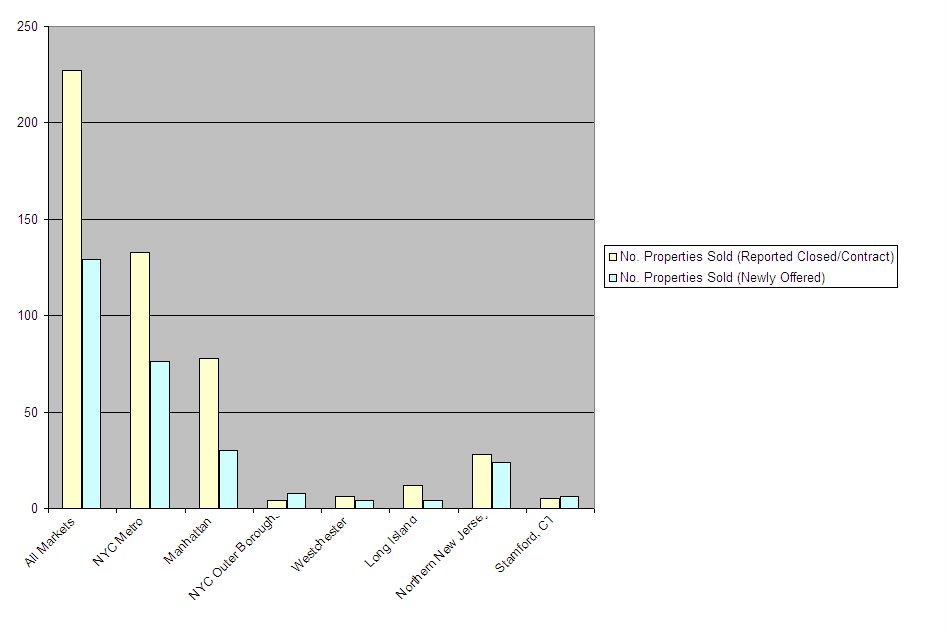
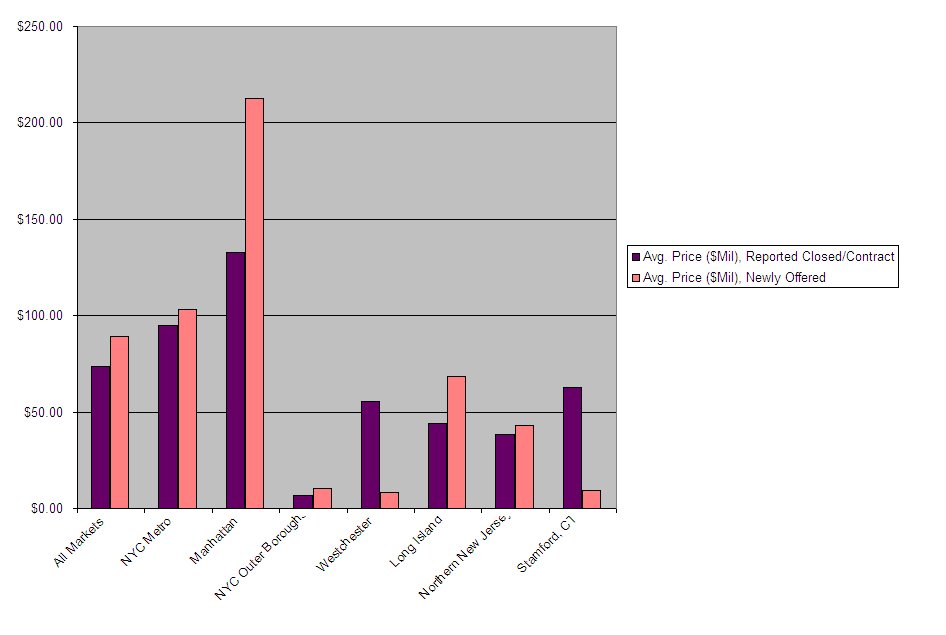
For at least the past year I have been bouncing redevelopment ideas involving The Bronx off of people in the real estate industry to mixed reaction. Hearing the President of Real Capital Analytics say the smart money was in the Bronx was a major shot in the arm and since then people have been more enthusiastic. Later on, I spoke to someone else there who is from the Bronx and we had a nice discussion on which types of real estate would be best to invest in now and why the Bronx has been neglected for so long.
An interesting thought I had is that perhaps people's fear of living and working in The Bronx creates a squeeze in the other boroughs, pushing up rents. If we consider that people looking for apartments who are not too constrained by their budgets usually want to live in Manhattan, Brooklyn and maybe Queens, as everyone crowds into these boroughs, it will drive prices there up. If more people went into The Bronx, it could have a moderating influence on prices, making housing as well as commercial space more affordable across the entire city. In short, the underutilization of The Bronx is likely costing everyone in New York City and perhaps the surrounding metropolitan area money. Whether or not this is true and if so how much money is it costing New Yorkers is a question for an economist.
Now that I have been taking classes at NYU in Real Estate development and financing I am learning that real estate investment is not totally out of reach for me, especially for a smaller deal. I went on a little real estate scouting trip in the Concourse/Highbridge area. I saw an empty brownstone for sale for some $550,000 but to get it to where I want it to be it would require a lot of renovation that I do not feel ready for. It has even been suggested that I be more ambitious and buy, say, an already occupied apartment building with an established rent roll so as to make it easier to get a loan. The missing ingredient is to find an equity partner.
And so the networking continues, changing focus here and there as the project evolves. Meanwhile I seek employment and have finals for my classes looming.
Following are some articles about real estate in The Bronx. I just hope that by the time I can get in that the market won't be saturated.
_____________________________________________________
Bronx Multifamily Portfolio Trades for $136M
By Katie Hinderer
Eastchester Heights(incidentally, this is not too far from where I live)NEW YORK CITY-Taconic Investment Partners and ING Clarion Partners has bought the 1,416-unit Eastchester Heights apartment complex here in the Bronx. The JV paid $136 million for the property.
Urban American LP and City Investment Fund jointly sold the portfolio which consists of low-rise, moderate-income housing at 1400 Hicks St., 3485 Corsa Ave., 3444 Fish Ave., 3438 Wilson Ave. and 3437 Eastchester Rd., according to David Berger, senior managing director with GFI Realty Services. Berger together with colleagues Aaron Jungreis and Jay Davidson represented the buyer and seller.
Berger tells GlobeSt.com “Taconic was interested [in the deal] as they have recently come back into the multifamily arena and this was a large, well maintained complex which rarely becomes available. They moved very quickly and aggressively to wrap up the deal, with a large deposit and a fast closing.” The purchasing JV plans to keep Eastchester Heights a rental community for middle-income families and will continue an interior unit renovation process that the previous owners began.
“Not so long ago, in the 1990s, this was a very troubled property, and because of that situation, the entire surrounding community was in danger of sliding downhill,” says Ari Shalam, director of acquisitions for Taconic. “But the preceding owners performed a heroic task in restoring the complex, physically and socially, to its current vital state. The entire Eastchester community is now a stable middle-class community on the upswing.”
Rents at the property average $14 per sf, but Shalam says he expects the rents to gradually increase as the area continues to improve. “This is an investment in the future of a Bronx community that’s been restored to life.”
This purchase is Taconic’s second recent foray into the middle-income housing sector. Last fall Taconic teamed with Apollo Real Estate Advisors and purchased about 1,000 apartments at Fairfield Towers in Brooklyn for $90 million. The JV is pouring $40 million into renovations to turn the property into a middle-income condo property.
_______________________________________________________
Mott Haven's real estate ascension is an uphill climb
A mix of promise and problems make future development prospects an iffy proposition in South Bronx neighborhood
By Alison Gregor
With an ample supply of empty industrial buildings and a smattering of picturesque town homes, Mott Haven in the South Bronx would seem to have the qualities needed to be the next Williamsburg. It has a booming, though tiny, antiques district and a section of residential apartments along Bruckner Boulevard near Lincoln Place, the result of a five-block rezoning done almost a decade ago.
Just north of that is a concentration of about 250 townhouses built in the late 1800s that have landmark status and currently sell for at least $500,000 each.
There's also some celebrity cachet – Mo Vaughn, former first baseman for the Mets, announced he is reviving two neglected Mott Haven housing projects.
But most importantly, say developers, Mott Haven has the location, location, location that is so important in real estate development. It's a short ride on the Lexington Avenue subway line from Midtown Manhattan, but also allows city residents easy highway access to the rest of the Northeast.
So why isn't this South Bronx neighborhood taking off?
"It's just not Williamsburg," said Sid Miller, a neighborhood real estate broker and founder of the Haven Heights Group. "The problem with Mott Haven is there is not enough supply of warehouses and brownstones in relation to housing projects, subsidized housing and five-story walk-up tenements."
Crime rates have dropped, as they have throughout the city, but the neighborhood remains highly segregated by race, ethnicity and class, residents say. While those fleeing Manhattan are doing so because they can't hack the borough's high rents, they still earn enough to push up Mott Haven prices – much to the chagrin of locals.
"It's a no-win situation," said Javie Diaz, who works as a bartender at the Bruckner Grill, a favorite watering hole for Mott Haven's newer residents. The bar opened two years ago in the antiques district. Diaz said he moved to Mott Haven almost a decade ago with his mother, who lives in the housing projects.
"Everyone who moves here likes it," he said, "But if you're going to move to this neighborhood, which doesn't have any amenities, you want to pay reasonable rents."
That's why he left his former apartment. Diaz said he recently moved from his cramped quarters at the Clock Tower loft building, a former piano factory converted into about 150 living spaces by Brooklyn-based developer Carnegie Management Corporation. The first spaces became available in 2002.
"In three years there, rent went up drastically," said Diaz. "A two-bedroom apartment is now $1,300 or $1,400 a month. That's way overpriced."
Other two-bedroom apartments in Mott Haven's antiques district offer more space for much less, about $900 a month, he said. Also, though the Clock Tower loft building was portrayed in several news articles as a bellwether of Mott Haven gentrification, it has been tied down in litigation from former tenants.
That negative publicity may also be hobbling Mott Haven's revival in general.
"No matter what it becomes, this neighborhood will still be the South Bronx," Diaz said.
The area's newest residents tend to live around Bruckner Boulevard or 133rd Street, except for those who purchase one of the townhouses, located in three small historic districts pocketed between 133rd and 144th streets. Some of these landmarked blocks look like they might have dropped out of Greenwich Village. Miller said he paid $50,000 for his four-story brownstone on 138th Street back in 1990. Now, it is probably worth about $600,000, he said.
"What do you get for half a million in Manhattan? A walk-up studio," he said. A row house in Mott Haven might have 12 rooms.
"What a great way to raise kids," he added.
But, ironically, that property appreciation is driving away many hardworking Hispanic families who have lived in Mott Haven for decades, even if they are cashing in on the increasing property values. For example, Jose Noyola, who runs a streetside clothing stand, put his four-story town home at 142nd Street and Willis Avenue on the market for $600,000 after buying it as a fixer-upper 12 years ago for $250,000.
"This is a poor neighborhood that has been improving, because there are some new houses," Noyola said. "But now, old-time families can't afford it."
Noyola's home, where he no longer has to pay down a mortgage, is registered as a church, so he doesn't have to pay taxes on it. Still, climbing prices for utilities have sunken him. "The utilities are so expensive, we can't afford to live here," said Noyola, who plans to pack up his family as soon as he sells out. "We're moving to Miami."
Some families bought townhouses for as little as $15,000 back in the 1960s, said Miller, and the properties have remained in the family since then. There is very little available in vintage townhouses for a purchaser who wants to move into Mott Haven.
But developers say there has been some new home construction. Still, the area north of 133rd Street in Mott Haven is dominated by government-subsidized housing projects that are decades old and might scare off some potential homebuyers.
"The problem is the quality of the housing stock there is very old," said Michael Schwartz of Equity Realty and Consulting Corporation, which does a lot of multifamily development in the Bronx. "At night, when the commercial and industry is gone, it's very barren. It's not a prime residential area."
In the meantime, neighboring communities like Port Morris are being rezoned to promote commercial and residential uses in largely abandoned industrial space, which may steal some of Mott Haven's thunder. Hunts Point is also seeing some urban in-fill home construction, developers say.
North of Mott Haven, near the Hub as well as around Yankee Stadium, along with neighborhoods like Melrose and Morrisania, residential development, almost all of it subsidized, is more widespread.
Schwartz said he believes only larger-scale construction of apartments may eventually allow rejuvenation to take a firm hold in Mott Haven.
"For it to be a prime area, there would have to be some concerted effort to develop a pocket or area with a major group of buildings, perhaps 300 or 400 units in four or five developments," he said. "Everything would then feed off that."
__________________________________________________________
A market-rate future for The Bronx
Development replaces demolition as borough stabilizes
By Alison Gregor, The Real Deal, October 2005
(top) A rendering of the new Yankee Stadium, which will anchor a new commercial hub in the South Bronx; (above) Mario Procida has developed 1,000 housing units in the Bronx and recently finished a strip mall. The recent history of Bronx real estate is a tale as much about demolition as development, but the future looks like an era of change.
A borough of stark contrasts, its northern section, which includes Riverdale, has always been ritzy and is now staving off large-scale development with restrictive zoning regulations. While the borough's less expensive areas have traditionally served as the steady source of housing for much of the city's working class, the South Bronx conjures up two principal images: Yankee Stadium and urban decay. Full of government-subsidized housing, the South Bronx is finally seeing the first tentative steps toward creation of market-rate condominiums.
As Bronx real estate prices rise, the question real estate professionals consider is simple: how high?
"There has been a steady stream of investment in the Bronx for the past two decades," said long-time Bronx developer Peter Fine, head of Atlantic Development Group. "We have done primarily rentals. But because the borough has increasingly stabilized, especially over the past five years, it's more viable today to try to do some kind of for-sale model."
The Bronx is hard to quantify as a potential ground for development, but some figures are clear. According to U.S. Census Bureau estimates, the Bronx is the city's second fastest-growing borough, behind Staten Island.
With almost 1.37 million people living in the Bronx, according to 2004 data, residential development has risen slowly and steadily. City building permit records show the rate of construction for apartment buildings is ahead of single-family houses.
Anthony Perez Cassino, chairman of Bronx Community Board 8, said the entire borough is undergoing a building revival. "I don't think there's anywhere in the Bronx that's not a good area to develop," he said.
Nowhere are the good times more evident than in the Riverdale and Kingsbridge neighborhoods in the northern Bronx, where zoning regulations were put in place to contain high-rise development in the swanky neighborhoods full of elegant single-family houses.
"This is the most development we've seen in Riverdale in several decades," said Bradford Trebach, an associate broker with Trebach Realty, which has operated in Riverdale for 33 years. "Most of these are luxurious condominium developments."
While the borough's northern environs duplicate an environment similar to surrounding posh Westchester County suburbs, the southern part of the borough is starting to blossom as prospective buyers get priced out of Manhattan.
While southern Bronx neighborhoods, such as Mott Haven, Port Morris, Melrose and Morrisania have seen their share of single- and multi-family homes in the past, they've also been home to large housing projects. Development of government-subsidized housing continues to this day, despite a legacy of problems with public housing, including crime, poor local schools and multiple generations of families living in poverty.
But developers have begun testing the market in the South Bronx with market-rate housing. The Jackson Development Group is putting up 28 condominiums in seven row houses near Yankee Stadium, which itself will be the site of a massive redevelopment effort that will see a new stadium next to the House That Ruth Built, as well as a hotel and convention center.
It remains to be seen if these market-rate units, with three-bedroom apartments reportedly going for $235,000 and two-bedrooms selling for $195,000, will actually find a market. Some developers say they are skeptical -- though it's not out of the realm of possibility.
Some, including former Bronx borough president and Democratic mayoral nominee Fernando Ferrer, call for a balance between market-rate and affordable housing.
"While the resurgence of the Bronx has had a significant positive benefit on the borough," Ferrer wrote in an email to The Real Deal, "we must continue to be mindful of the effects a quickly rising market can have on the less fortunate New Yorkers. [But] the construction of new apartments does not necessarily mean the loss of housing families can afford. We can strike a balance by providing incentives for developers to include affordable housing units in their projects."
Mario Procida, head of Procida Construction Corp., has developed about 1,000 units throughout the Bronx since he began working there in the mid-1970s. His firm was one of the first to collaborate with the city's Partnership New Homes Homeownership Program.
"That has largely been the generator for the redevelopment of the most underserved areas of the city, like the Bronx," Procida said. "People may call it affordable housing, but it's really housing that meets the needs of the market."
Procida is working with L & M Equity Participants, Nos Quedamos and Melrose Associates to build a mix of 324 residential units of cooperative housing, rental apartments and multi-family homes in Melrose that will be affordable for people earning low to moderate incomes. He said that even with the cheap cost of land in the Bronx and increasing real estate prices, it's still not possible to do market-rate housing.
"It's very difficult to do anything here without government assistance," Procida said.
Martin Dunn, president of Dunn Development Corp., which has affordable projects going up in Morris Heights, Morrisania and Highbridge, agreed. He also said that, like everywhere else in New York City, the Bronx is seeing a shortage of land for development purposes.
"It used to be land was the last of our worries," Dunn said. "The obstacle used to be getting housing subsidies. But now, finding land is a significant hurdle."
As recently as 1999, Dunn said he bought a piece of land in the South Bronx at city auction for $4 a buildable square foot. Within a couple of blocks of that site, the price of land has more than quintupled to $25 a buildable square foot, he said.
"Land prices have just been jumping and jumping," Dunn said.
Other developers are a bit more optimistic. Ron Moelis, principal of L & M Equity Participants, said that besides the collaboration with Procida in Melrose, the company has about seven projects going on in that neighborhood, among others throughout the borough. L & M projects include two low- and middle-income rental projects at 156th Street and Melrose Avenue and 1011 Washington Avenue.
"There is starting to be more middle-income, even upper-middle-income housing being developed since the Bronx is more affordable than other parts of New York City," Moelis said. "Neighborhoods are gaining commercial infrastructure, and I think that will help."
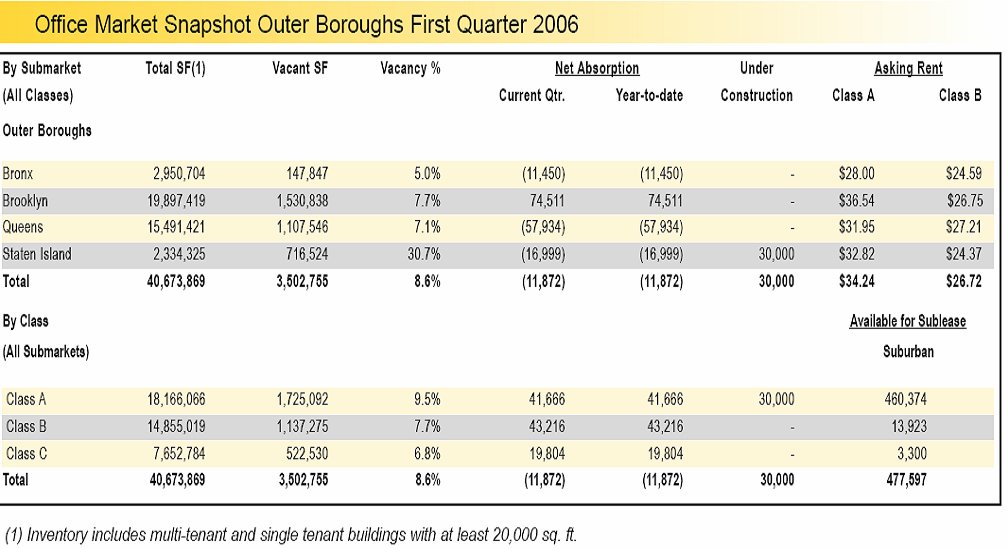
Besides the new Yankee Stadium, there is other commercial development stabilizing the Bronx. BTM Development, a unit of the Related Companies, has plans for a 1-million-square-foot shopping mall called Gateway Center to go up at the former Bronx Terminal Market near Yankee Stadium. The Hutchinson Metro Centro in far-flung Pelham Bay increased the borough's Class A and B office space by 25 percent when it opened in June 2004 with nearly 500,000 square feet. Following the project's initial success, there are now plans to add another 650,000 square feet at the site.
A new mall of at least 200,000 square feet will be going in this year at 230th Street and Broadway in Kingsbridge, and Procida said his company has just completed a 14,000-square-foot strip mall and other commercial space at the Hub.
All of this new commercial development adds services for a borough that has been drastically underserved through the years, property developers say.
"There hasn't been much commercial real estate development over the past 20, 30 years," Fine said. "Since the population has stabilized and there is more solid housing stock, I think developers are feeling more confident there's a demographic base to do commercial development."
posted by Malaika Martin at 4:55 PM
|
1 comments